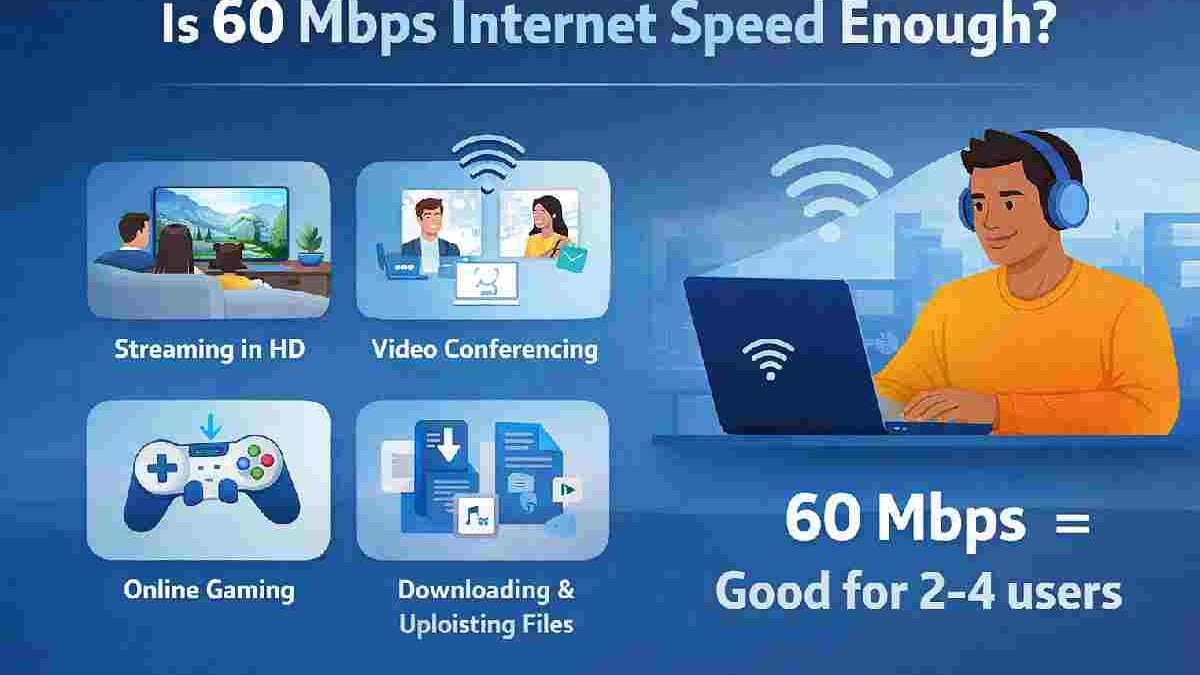

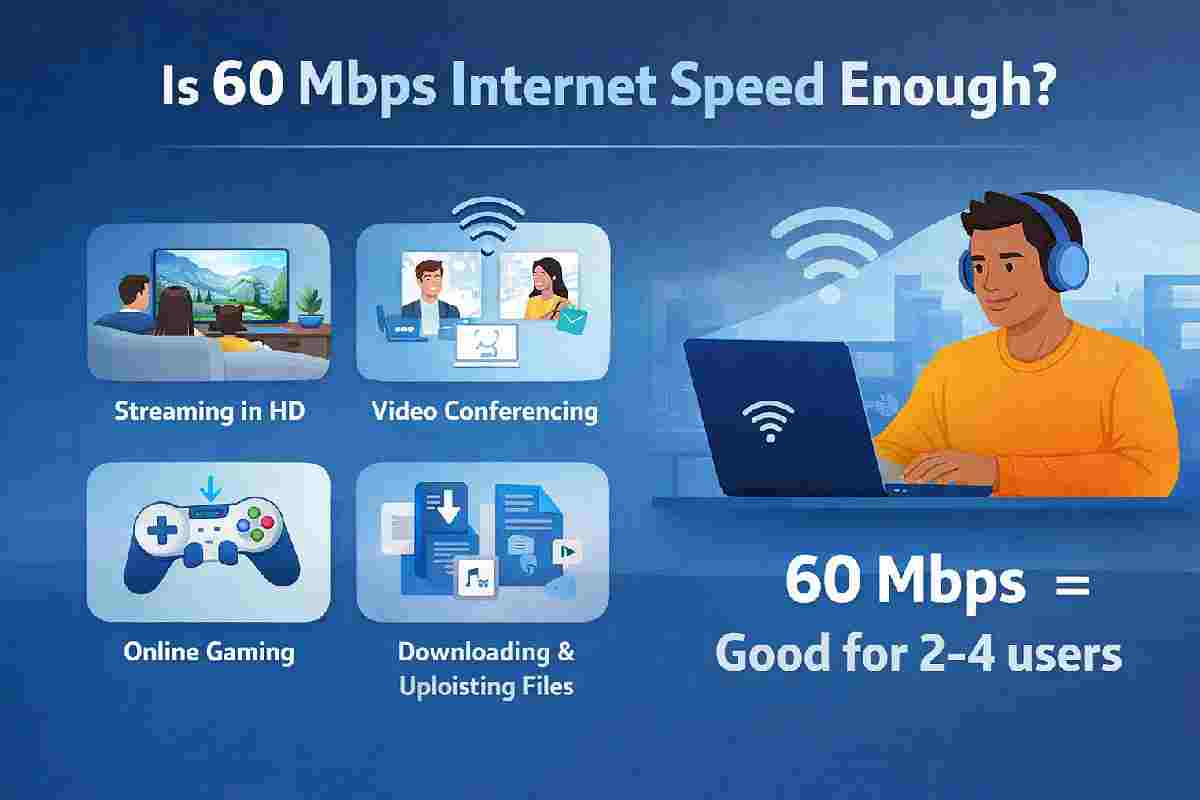
60 Mbps – In today’s hyper-connected world, internet speed is no longer a luxury—it’s a necessity. Whether you’re working remotely, binge-watching your favorite shows, gaming online, or attending virtual meetings, your internet speed plays a crucial role in shaping your digital experience.
One of the most commonly offered plans by internet service providers is 60 Mbps. But the question remains:
Is 60 Mbps fast enough?
Who should use it?
Where does it fall in the overall speed spectrum?
Let’s explore everything you need to know in a simple, human-friendly, and practical way.
Table of Contents
What Does 60 Mbps Mean? (Simple Definition)
60 Mbps (Megabits per second) refers to how much data your internet connection can download or upload in one second.
- 1 Mbps = 1 million bits per second
- 60 Mbps = 60 million bits per second
In real-life terms:
- You can download a 1 GB movie in about 2–3 minutes
- Stream videos without buffering
- Run multiple devices smoothly
Understanding the Internet Speed Spectrum
Internet speeds are usually divided into categories based on performance and usage.
Speed Spectrum Table
| Speed Range | Category | Suitable For |
| 1–10 Mbps | Very Slow | Basic browsing, emails |
| 10–25 Mbps | Slow | SD streaming, light usage |
| 25–50 Mbps | Moderate | HD streaming, small households |
| 50–100 Mbps | Fast | Streaming, gaming, work from home |
| 100–500 Mbps | Very Fast | Large families, 4K streaming |
| 500+ Mbps | Ultra-Fast | Heavy usage, smart homes, businesses |
60 Mbps falls under the “Fast” category.
Is 60 Mbps Fast Enough?
Yes—60 Mbps is considered fast for most users.
However, “fast” depends on your usage habits.
Let’s break it down:
Perfect for:
- 3–6 devices connected simultaneously
- HD and Full HD streaming
- Work-from-home tasks
- Online classes and Zoom calls
- Casual gaming
May struggle with:
- Large households (8+ devices)
- 4K streaming on multiple screens
- Heavy online gaming + downloads simultaneously
What Can You Do with 60 Mbps?
Here’s a practical breakdown of everyday activities and how well it supports them:
Usage Capability Table
| Activity | Speed Requirement | 60 Mbps Performance |
| Web browsing | 1–5 Mbps | Excellent |
| HD streaming | 5–10 Mbps | Smooth |
| 4K streaming | 20–25 Mbps | Good (1–2 devices) |
| Video calls (Zoom/Meet) | 3–6 Mbps | Stable |
| Online gaming | 10–25 Mbps | Good |
| File downloads | High | Fast |
| Smart home devices | Low | Excellent |
How Many Devices Can 60 Mbps Handle?
The number of devices matters just as much as speed.
Device Capacity Table
| Number of Devices | Experience Quality |
| 1–2 devices | Excellent |
| 3–5 devices | Very Good |
| 6–8 devices | Good |
| 8+ devices | May slow down |
For a small to medium household, 60 Mbps works beautifully.
Streaming Experience with 60 Mbps
It is one of the most common uses of internet today.
Streaming Quality Breakdown
| Video Quality | Required Speed | 60 Mbps Support |
| SD (480p) | 3 Mbps | Excellent |
| HD (720p) | 5 Mbps | Smooth |
| Full HD | 8 Mbps | Perfect |
| 4K UHD | 25 Mbps | Limited (1–2 screens) |
You can comfortably stream Netflix, YouTube, and OTT platforms without buffering.
Is 60 Mbps Good for Gaming?
Yes—but with some considerations.
Gaming Needs More Than Speed
It depends on:
- Ping (latency)
- Stability
- Server distance
Gaming Performance Table
| Game Type | Performance on 60 Mbps |
| Casual mobile games | Excellent |
| Multiplayer games | Good |
| Competitive esports | Good (low ping needed) |
| Game downloads | Fast |
If you’re a serious gamer, you might need higher speeds or fiber connection.
Work From Home with 60 Mbps
Remote work has changed how we use the internet.
WFH Suitability
| Task | Performance |
| Zoom/Google Meet | Smooth |
| File uploads/downloads | Fast |
| Cloud work | Reliable |
| Multiple meetings | Good |
For freelancers, students, and remote workers—60 Mbps is more than enough.
Download & Upload Speeds Explained
Most plans advertise download speed, but upload speed also matters.
Typical Scenario:
- Download: 60 Mbps
- Upload: 10–20 Mbps
Why Upload Matters:
- Video calls
- Uploading files
- Live streaming
If you upload frequently, check your provider’s upload speed.
Factors That Affect Your 60 Mbps Speed
Even with a 60 Mbps plan, your experience may vary.
Key Factors:
- Wi-Fi Router Quality
- Distance from Router
- Number of Devices Connected
- Network Congestion
- Type of Connection (Fiber vs DSL)
60 Mbps vs Other Speeds
Let’s compare 60 Mbps with other popular plans.
Comparison Table
| Speed | Best For | Verdict |
| 30 Mbps | Small usage | Limited |
| 60 Mbps | Medium households | Balanced |
| 100 Mbps | Heavy streaming/gaming | Better |
| 200+ Mbps | Large families/business | Premium |
60 Mbps is the sweet spot for affordability and performance.
Who Should Choose 60 Mbps?
This speed is ideal for:
Perfect Users:
- Small families (2–5 people)
- Students
- Remote workers
- Casual gamers
- OTT lovers
Not ideal for:
- Tech-heavy homes
- Professional gamers
- Content creators (large uploads)
- Offices with many users
Advantages of 60 Mbps Internet
Key Benefits:
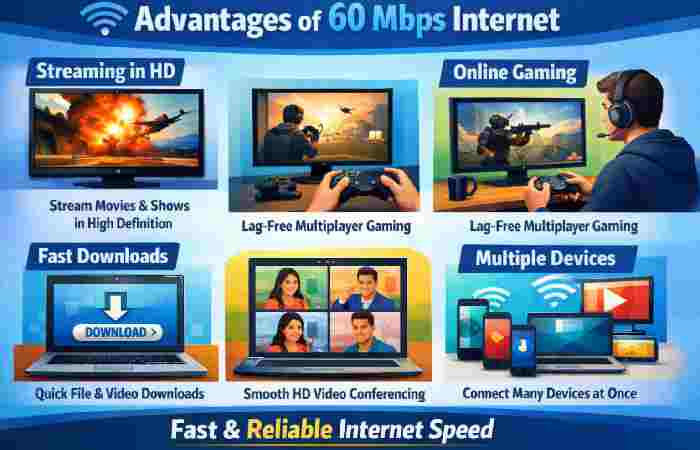
- Affordable pricing
- Smooth HD streaming
- Supports multiple devices
- Good for work and entertainment
- Low buffering issues
Limitations of 60 Mbps
No speed is perfect.
Downsides:
- Limited for heavy 4K streaming
- Can slow down with many users
- Upload speed may be lower
- Not future-proof for ultra-heavy usage
Tips to Maximize Your 60 Mbps Speed
Even a good plan needs optimization.
🔧 Simple Tips:
- Place router in a central location
- Use a dual-band or Wi-Fi 6 router
- Limit background downloads
- Use Ethernet for gaming/work
- Restart router regularly
Fiber vs Broadband: Does It Matter?
Yes, the type of connection impacts performance.
Comparison Table
| Type | Performance with 60 Mbps |
| Fiber | Stable & fast |
| Cable | Good |
| DSL | Slower & unstable |
Always prefer fiber connection if available.
Future-Proofing: Is 60 Mbps Enough in 2026?
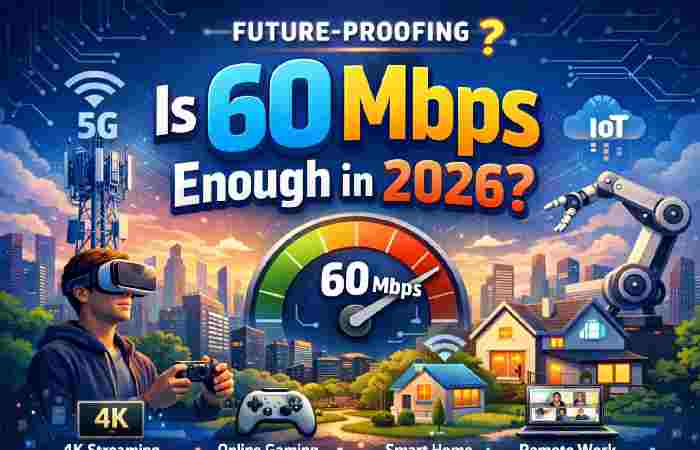
With increasing internet demand:
- Smart homes
- 4K/8K streaming
- AI tools
- Cloud gaming
60 Mbps is good for now, but may feel limited in future heavy-use scenarios.
Final Verdict: Is 60 Mbps Fast?
Yes, 60 Mbps is a fast and reliable internet speed for most users.
It strikes a perfect balance between:
- Performance
- Cost
- Usability
In Simple Words:
- Fast enough for daily life
- Great for small families
- Ideal for streaming & work
- Not for heavy tech users
Conclusion
Choosing the right internet speed doesn’t mean picking the highest number—it means selecting what fits your lifestyle.